原文把「知识双盲」讲得很清楚——客户懂业务不懂模型,实验室懂模型不懂业务,两边合起来才能把东西做上线。这个判断我在交付一线完全认账,但它漏了决定这个模式生死的前提:Palantir 的 FDE 之所以成立,不是因为工程师坐进了客户现场,而是每次驻场沉淀的集成、prompt、数据管道最终都回流成了平台的产品能力。驻场本身是成本项,产品回流才是收入项。国内不少团队学 FDE 只学前半句,人常年泡在客户现场,交付物全是客户私有的 one-off 脚本,两年下来就是一家毛利更差的外包公司——这是原文没讲的第一坑:没有产品回流闭环的 FDE,本质是高级定制外包,所谓的黏性来自客户懒得换人,而不是换不起系统。
第二坑在退出机制。原文说 FDE「stays until it runs in production」,实战里这只是必要条件:我见过太多系统在 FDE 撤场三个月内腐烂,不是代码差,是客户侧没有指名 owner,没人敢动、没人会修。供应链和跨境场景还多一层——你嵌进客户 VPC 的那一刻,工程师本人就成了数据出境的一条路径,这不再只是技术问题,而是合规问题。对个人,风险同样被低估:客户特定知识攒得越多,可迁移性越差,议价能力押在雇主品牌上,跳出这家公司,简历上的 FDE 在很多招聘方眼里只是「驻场过的工程师」。
给你一条可执行的建议:下个项目签 SOW 时,把「客户侧指名对接人+每周投入工时+撤场后运维责任归属」写成硬条款。客户不肯指定对接人的项目,基本可以预判会滑向无限期驻场外包——这条判断标准,比任何方法论都便宜好用。
—— FDEChina编辑部 · 实战派
# What is a Forward Deployed Engineer: The AI Role OpenAI, Anthropic, and Google Are Hiring in 2026
来源:Michal Sutter · 2026-05-21T04:58:31+00:00
Artificial Intelligence
AI Infrastructure
Technology
AI Shorts
Applications
Editors Pick
For Devs
Language Model
Software Engineering
Staff
Tech News
What is a Forward Deployed Engineer: The AI Role OpenAI, Anthropic, and Google Are Hiring in 2026
A plain-language guide for early-career AI engineers, software engineers, and data scientists.
What is a Forward Deployed Engineer?
The term ‘Forward Deployed Engineer’ (FDE) sounds military. That is intentional.
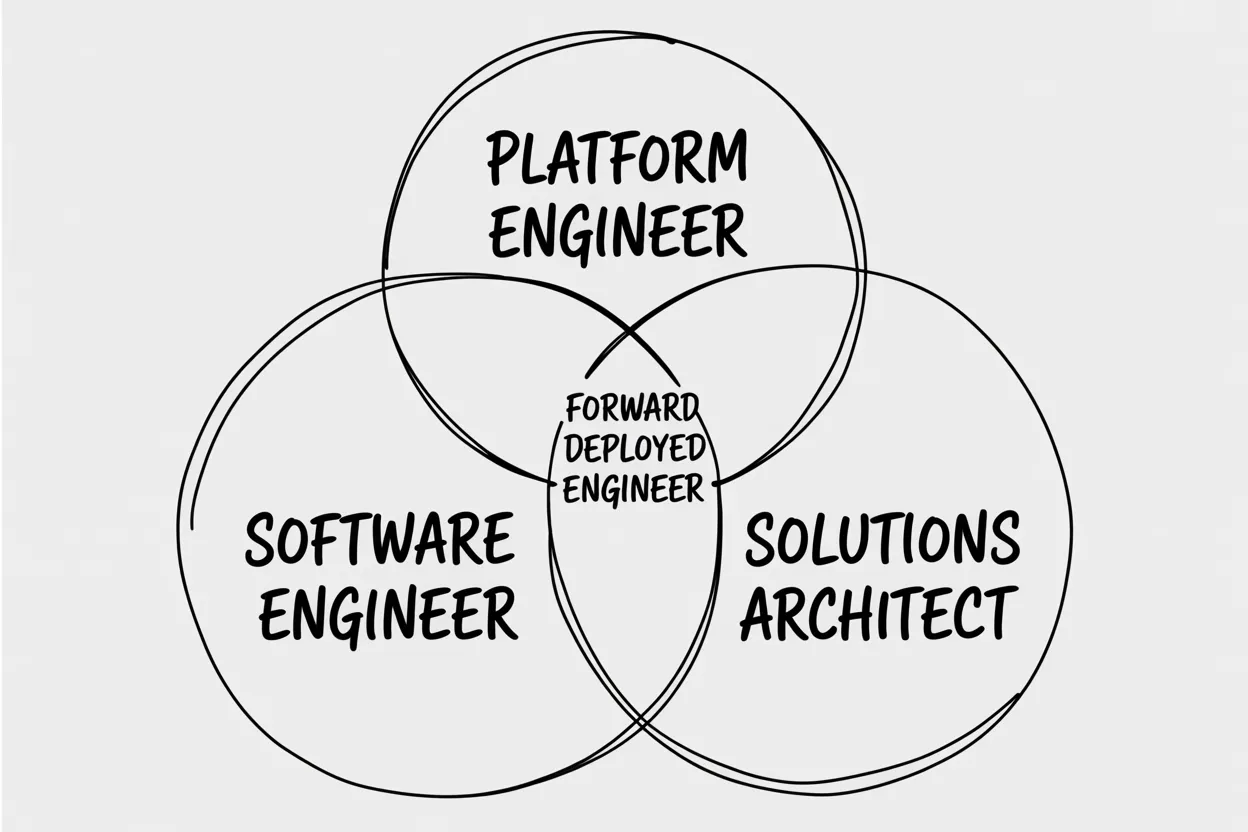
A Forward Deployed Engineer is a software engineer who works embedded with the customer’s technical and operational environment on-site, hybrid, remote, or inside a customer cloud or VPC, depending on the engagement. The FDE does not sit at a home office writing documentation. The FDE works alongside the client’s domain experts, inside the client’s workflows, and writes real code that runs in the client’s production systems.

The role differs from traditional advisory consulting because FDEs own implementation and production delivery. Consultants write reports and recommendations; an FDE builds the actual system and stays until it runs in production. The role was coined by Palantir in the early 2010s, and it emerged from a problem Palantir could not solve any other way.
The Origin: Palantir’s Intelligence Agency Problem
Palantir was founded in 2003 to help U.S. intelligence agencies make sense of large, fragmented datasets. The problem was not purely technical.
Intelligence agencies could not clearly describe what they needed. They could not openly share their data. Their workflows changed constantly. A traditional software product could not keep up. Palantir’s engineers had to go inside the agencies and work out the problem on-site. These early on-site engineers were called ‘Deltas.’
Until 2016, Palantir had more FDEs than software engineers. That ratio is unusual by software company standards. It shows how central the embedded model was to the business from the start.
The FDE role was inspired by how high-end French restaurants operate. The front-of-house staff is deeply integrated with the kitchen. They are empowered to tell customers ‘no’ if the customer is ordering incorrectly. Palantir applied that same philosophy to enterprise software delivery.
Why Standard SaaS Does Not Work for Complex AI Deployments
To understand why the FDE model is trending now, you need to understand where the standard SaaS model breaks down.
The standard enterprise software motion looks like this:
A company builds a product.
The sales team pitches it to clients.
A customer success manager helps with onboarding.
The client’s internal team integrates it.
This works for well-understood products like a CRM, a project management tool or an analytics dashboard. These have documented APIs, predictable behavior, and large communities who share implementation patterns.
AI systems break this model. There is a knowledge gap on both sides.
The client’s engineers know their business deeply: the data schemas, the compliance requirements, the edge cases, the legacy system architecture. The AI lab’s engineers know how models behave in production: the prompting patterns, the retrieval-augmented generation (RAG) strategies, the evaluation frameworks, the failure modes that appear only at scale.
Neither side has the other’s knowledge. And you need both to ship something that runs in production.
A customer success manager cannot bridge this gap. Documentation cannot bridge it. An FDE can.
This is why MIT NANDA’s State of AI in Business 2025 report found that 95% of enterprise generative AI pilots show no measurable business impact. The models are not the problem. The deployment is.
Palantir’s Operational Evidence
Before analyzing what OpenAI and Anthropic are doing, it is worth examining Palantir’s results. They provide the most direct proof of concept.
Palantir went public via a direct listing on September 30, 2020, with a reference price of $7.25 per share. The stock opened at $10 and closed its first day at $9.50. It rose to highs near $39 in early 2021, then dropped to around $6 in late 2022. Critics questioned the model throughout this period. The FDE approach looked too expensive and did not scale like a pure SaaS product.
The stronger evidence is operational. Palantir’s Q1 2026 investor release confirmed 85% total year-over-year revenue growth, U.S. government revenue up 84% year-over-year, and U.S. commercial revenue up 133% year-over-year. Palantir raised its full-year 2026 revenue guidance to 71% year-over-year growth. Those numbers reflect what the embedded deployment model produces at scale, in a competitive market, after years of iteration.
The FDE model produced a specific kind of revenue: sticky revenue. When an FDE team spends months inside a client organization building a system that integrates with the client’s internal data pipelines, that client does not switch vendors the following year. The switching cost is not a subscription cancellation. It is rebuilding an entire system woven into how the organization operates. High acquisition cost, very high retention, very high contract value. That is the economic structure the FDE model produces.
The Technical Skills FDEs Must Have
It is useful to be precise about the technical gaps FDEs bridge.
Prompt architecture: Writing a prompt that works in a demo is not the same as one that works reliably across thousands of production inputs. FDEs design prompt architectures like system prompts, few-shot examples, structured output formats, and guardrails that hold up under real-world variation.
Retrieval-Augmented Generation (RAG) pipelines: Most enterprise use cases require the model to reason over internal company data absent from the model’s training data. RAG involves embedding documents into a vector database (such as Pinecone, Weaviate, or pgvector), retrieving relevant chunks at inference time, and injecting them into the prompt context. The pipeline design like chunking strategy, embedding model, similarity metric, and reranking logic significantly affects output quality. FDEs configure this for the client’s specific data.
Evaluation frameworks: Anthropic’s FDE job specification requires “production experience with LLMs including advanced prompt engineering, agent development, evaluation frameworks, and deployment at scale.” Building evaluation suites that catch hallucinations, regressions, bias, and grounding gaps before production is a non-negotiable FDE skill in 2026. OpenAI’s own documentation describes this with John Deere: “after reviewing hundreds of real-world examples with domain experts, building custom evaluation systems to measure accuracy, and iterating.”
Agent development: As enterprises move from single-step inference to multi-step agentic workflows, FDEs need hands-on experience with agent frameworks. These include LangGraph, LangChain, CrewAI, and DSPy. They also need experience with multi-step tool-use chains where models call external APIs, read from databases, or write to internal systems within a single workflow.
Production observability: Models behave differently in production than in development. FDEs implement logging, monitoring, and alerting systems that track model outputs over time, including latency, token usage, error rates, and output drift.
Security, compliance, and data governance: Enterprise clients in financial services, healthcare, and government have strict data handling requirements. FDEs must understand how to deploy models inside client-controlled infrastructure, which often means running models on-premises or in a private cloud rather than calling a public API endpoint.
OpenAI’s Forward Deployed Engineering Team
OpenAI began building its Forward Deployed Engineering team in late 2024 and accelerated hiring through 2025. The OpenAI FDE job description describes the role directly:
Forward Deployed Engineers lead complex deployments of frontier models in production. You will embed with customers where model performance matters, delivery is urgent, and ambiguity is the default.
The role required up to 50% travel. Salaries ranged from $160,000 to $280,000 annually for mid-level positions in San Francisco. The team operates at the intersection of customer delivery and core product development, feeding deployment patterns back into OpenAI’s roadmap.
OpenAI’s FDE work at BBVA is a documented example. BBVA partnered with OpenAI to build an AI-native bank at global scale. What began as a ChatGPT Enterprise deployment expanded into a system now serving 120,000 employees across 25 countries.
The John Deere deployment is a second example. OpenAI FDE teams worked alongside John Deere’s domain experts to deploy AI-powered planting recommendations for farmers. The process involved reviewing hundreds of real-world examples, building custom evaluation systems, and iterating on model performance. The outcome: John Deere helped farmers reduce chemical usage by up to 70%.
There is a competitive context behind the timing. According to Menlo Ventures’ 2025 mid-year LLM market update, Anthropic held approximately 32% enterprise LLM market share, OpenAI approximately 25%, and Google approximately 20%, with OpenAI down from around 50% in 2023. The Deployment Company is, in part, a structural response to that shift.
On May 11, 2026, OpenAI formalized its FDE approach at scale. OpenAI confirmed the formation of “The Deployment Company” — a joint venture majority-owned and controlled by OpenAI. The venture raised over $4 billion from 19 investors, anchored by TPG, with Advent International, Bain Capital, and Brookfield Asset Management as co-lead founding partners. Additional named partners include Goldman Sachs, SoftBank Corp., Warburg Pincus, BBVA, and B Capital. Consulting and systems integration firms — including Bain & Company, Capgemini, and McKinsey & Company — are also founding partners. OpenAI’s official announcement confirmed more than $4 billion in initial investment and majority ownership; separate media reports, including from Axios, described the vehicle as having a reported pre-money valuation of approximately $10 billion, with a higher post-money structure.
OpenAI’s own financial commitment is $500 million in equity at close, with an option to contribute up to $1 billion more — for a total potential commitment of up to $1.5 billion. Reuters and Financial Times reporting indicated that private equity investors in the venture are reportedly guaranteed a 17.5% annual return over five years, with OpenAI retaining super-voting shares to keep strategic control. OpenAI has not confirmed the 17.5% figure in its official announcement. The venture is led by OpenAI COO Brad Lightcap. OpenAI also acquired Tomoro — an applied AI consulting firm bringing approximately 150 engineers with prior deployment experience at companies including Tesco, Virgin Atlantic, and Supercell — to build out the FDE team’s existing client experience.
Anthropic’s Enterprise Joint Venture
On May 4, 2026 — days before OpenAI’s announcement — Anthropic confirmed a parallel initiative.
Anthropic announced the formation of a new AI-native enterprise services firm alongside Blackstone, Hellman & Friedman, and Goldman Sachs as founding partners. Additional backing came from Apollo Global Management, General Atlantic, GIC, Leonard Green, and Sequoia Capital. The venture is valued at $1.5 billion, with a $300 million founding commitment split between Anthropic, Blackstone, and Hellman & Friedman.
Blackstone President and COO Jon Gray stated the venture aims to break down “one of the most significant bottlenecks to enterprise AI adoption” — specifically, the scarcity of engineers who can implement frontier AI systems at speed.
According to Anthropic’s CFO Krishna Rao: “Enterprise demand for Claude is significantly outpacing any single delivery model.” That statement directly explains the FDE pivot. Anthropic cannot serve enterprise demand at scale through API access alone.
Goldman Sachs’s Global Head of Asset Management Marc Nachmann described the goal as “democratizing access to forward-deployed engineers” for mid-market companies.
The new firm is a standalone entity with Anthropic engineering and partnership resources embedded directly within its team. The initial customer base is drawn from the portfolio companies of the investing firms. As TechCrunch reported, Anthropic described the engagement model directly: “An engagement might begin with the company’s engineering team sitting down with clinicians and IT staff to build tools that fit into the workflows that staff already use.” That is a straightforward FDE deployment description.
The new firm’s structure mirrors Palantir’s forward-deployment model and directly competes with traditional consulting firms for enterprise AI implementation work.
Marktechpost’s Visual Explainer
A Forward Deployed Engineer (FDE) is a software engineer who works embedded with a client’s technical and operational environment — on-site, hybrid, or inside the client’s cloud or VPC. The FDE writes production code directly inside the client’s systems.
The role differs from advisory consulting. Consultants deliver reports. FDEs deliver working systems and stay until those systems run reliably in production.
Palantir coined the model in the early 2010s to serve U.S. intelligence agencies whose requirements were too sensitive and too complex to articulate in a product brief. These early FDEs were called “Deltas.” Until 2016, Palantir had more FDEs than software engineers.
Key Takeaways
The FDE model embeds engineers inside client organizations to ship production AI — not slides, not docs, working code.
Enterprise AI pilots fail 95% of the time not because models are weak, but because deployment is broken.
Palantir’s Q1 2026 results (85% revenue growth, 133% U.S. commercial growth) are the clearest proof the embedded model works at scale.
OpenAI ($4B+ raised, The Deployment Company) and Anthropic ($1.5B JV with Blackstone and Goldman Sachs) both launched FDE ventures in May 2026 within days of each other.
For AI engineers, the FDE skill stack — RAG pipelines, eval frameworks, agent development, production observability — is now the most in-demand and least saturated path in enterprise AI.
Also, feel free to follow us on Twitter and don’t forget to join our 150k+ ML SubReddit and Subscribe to our Newsletter. Wait! are you on telegram? now you can join us on telegram as well.
Need to partner with us for promoting your GitHub Repo OR Hugging Face Page OR Product Release OR Webinar etc.? Connect with us

Michal Sutter
Michal Sutter is a data science professional with a Master of Science in Data Science from the University of Padova. With a solid foundation in statistical analysis, machine learning, and data engineering, Michal excels at transforming complex datasets into actionable insights.
原文链接
- Artificial Intelligence
- AI Infrastructure
- Technology
- AI Shorts
- Applications
- Editors Pick
- For Devs
- Language Model
- Software Engineering
- Staff
- Tech News
- Michal Sutter
- https://www.marktechpost.com/2026/08/11/the-video-production-stack-now-fits-on-one-desk-ltx-2-5-launches-as-nvidia-accelerated-open-weights-world-model/
- coined by Palantir
- Palantir was founded in 2003
- Until 2016, Palantir had more FDEs than software engineers
- you need both to ship something that runs in production
- MIT NANDA’s State of AI in Business 2025 report
- September 30, 2020
- Palantir’s Q1 2026 investor release
- OpenAI’s own documentation describes this with John Deere
- OpenAI FDE job description-sf-san-francisco/)
- BBVA partnered with OpenAI to build an AI-native bank at global scale.
- OpenAI FDE teams worked alongside John Deere’s domain experts
- According to Menlo Ventures’ 2025 mid-year LLM market update
- OpenAI confirmed the formation of “The Deployment Company”
- Reuters and Financial Times reporting
- Anthropic announced
- Blackstone President and COO Jon Gray stated
- Anthropic’s CFO Krishna Rao
- Goldman Sachs’s Global Head of Asset Management Marc Nachmann described
- As TechCrunch reported
- The new firm’s structure mirrors Palantir’s forward-deployment model
- 150k+ ML SubReddit
- our Newsletter
- now you can join us on telegram as well.
- Connect with us
- https://www.marktechpost.com/author/michal-sutter/
- Michal Sutter